Lobbying for Heat Pumps
Clean Heating
The world is struggling to come to terms with climate change.
Every thinking person knows that over the last 60 years
we have been burning fossil fuels – for heating, cooling, transport and electricity generation –
at a far greater rate than the fossil fuels were laid down over the 60 million years of the carboniferous era.
While we don't know how to fly commercial aeroplanes without burning fossil fuels,
we do have ways of generating electricity without burning fossil fuels
– and we know it is no longer necessary to burn fuel to heat buildings.
The alternative is to use heat transfer: this means using heat pumps.
Heat pumps can not only transfer heat from one place to another,
they can concentrate the heat by using the same vapour compression cycle used in every refrigerator in the land.
Clean Air
There is increasing awareness that poor air quality is contributing to up to 40,000 premature deaths
in the UK each year – and up to 10,000 premature deaths in London alone.
The chief contributors to these diseases are increasing levels of NO2 and particulate matter and these come largely from combustion.
While a significant proportion of this pollution comes from internal combustion engines, including diesel engines,
there is also a very significant contribution from combustion used for heating,
including up to 22% of the NO2 in London being attributable to heating from gas boilers.
The alternative to using gas boilers for heating is to use heat transfer: this means using heat pumps.
Heat pumps emit no gases at all on-site.
The electricity that they use may issue CO2 and NO2 at the power stations – if the power comes from a generating station based on combustion.
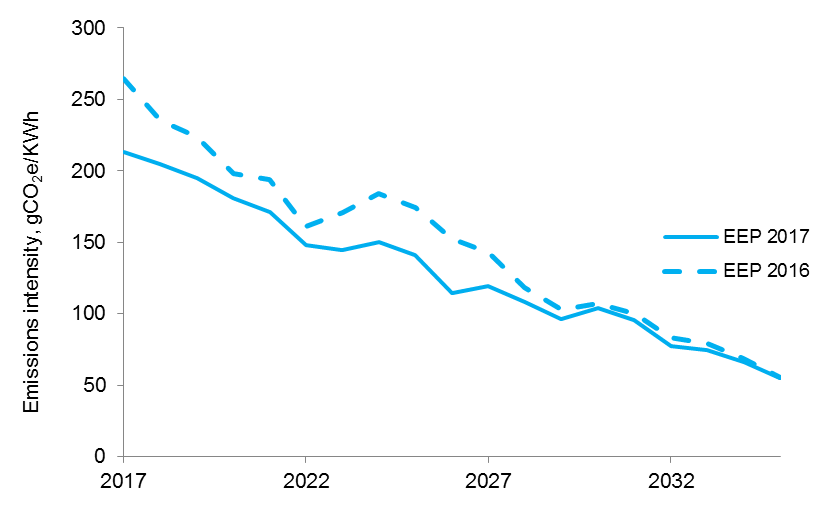
However, coal fired power stations are being phased out and the carbon factor of grid generation has been falling rapidly
and BEIS estimates that the emissions intensity of grid carbon
will fall dramatically within the life of heat pumps now being installed.
Efficiency of heat pumps
An air source heat pump can transfer 3 kilowatts of heat into a building for the cost of 1 kilowatt of electricity.
2.69 pence/kWh is contributed by Ofgem for each kWh of heat transferred into a commercial building from the Renewable Heat Incentive (RHI) –
so the cost of renewable heating is subsidised over the next 20 years.
If using an air source heat pump to heat a domestic property
Ofgem pays 10.49 pence/kWh for each kWh of heat transferred over the next 7 years –
so the RHI is much larger than the cost of electricity used
and amounts to a capital contribution to the cost of installing the heat pump.
Further advantages of using a ground source heat pump
While this page has covered air source heat pumps up to this point,
if there are investment funds to allow the heat pump to be connected to a ground array
there are significant further benefits of a well-designed ground source heat pump installation:
- increased efficiency of heating in winter (as the temperature from the ground will be warmer than from the air)
- increased efficiency of cooling in summer (as the temperature from the ground will be colder than from the air)
- any transfer of heat from the ground in winter will increase the efficiency of cooling in the following summer
- any transfer of heat to the ground in summer will increase the efficiency of heating in the following summer
For these reasons a well-designed ground source heat pump installation can
transfer 4 or 5 kilowatts of heat into a building for the cost of 1 kilowatt of electricity.
9.36 pence/kWh is contributed by Ofgem for each kWh of heat transferred into a commercial building
by a ground source heat pump from the RHI –
so the cost of heating over the next 20 years is heavily subsidised.
If using a ground source heat pump to heat a domestic property
Ofgem pays 20.46 pence/kWh for each kWh of heat transferred over the next 7 years –
so the RHI is much larger than the cost of electricity used
and amounts to a capital contribution to the cost of installing the heat pump.
For additional benefits of using ground source energy
see Ground Source Lobbying.